
Riding Dependency Toward Truth
- Wilbert Greenfield

- Jan 12
- 4 min read
Updated: Jan 29
My journey overcoming the fears of "Asking for Help"
by "The Unshakeable Pen"
He used to measure freedom by motion.
By how far he could go without asking.
By how much weight he could carry alone.
By how little he needed anyone.
He was an Alpha man—strong-willed, decisive, a provider. The kind of man who fixed things before they broke and showed up before anyone asked. Independence wasn’t just a trait; it was his identity. Asking for help felt like surrender, like handing over the keys to his manhood.
The Jolly Green"Field" Giant

10th President of Johnson C. Smith University & Virginia Stale University
I was raised in the presence of a giant.
My father was an Alpha among Alphas—a civil rights activist who stood when standing was dangerous, Dean of Biology at Jackson State University—during the rise of the civil rights movement, an HBCU college president who shaped minds and futures, a man whose name carried weight in rooms I hadn’t yet entered. He wasn’t just respected; he was relied upon. The community looked to him for leadership, courage, and vision. And at home, I watched him lead with the same quiet authority.
I grew up walking behind his shadow—not hiding in it, but honoring it. I learned early what strength looked like. Strength was discipline. Strength was sacrifice. Strength was showing up no matter how tired you were. Weakness wasn’t discussed; it simply wasn’t an option. I became that man too.

I built a life marked by accomplishment. I led. I provided. I carried responsibility well. I was known as capable, dependable, strong. And I wore that identity with pride—not arrogance, but inheritance. I was my father’s son.
Then ALS entered my life.
At first, I treated it like an obstacle to overcome. That’s what men like us do. We push harder. We adapt. We refuse to be defined by limitations. I told myself I could manage it quietly, privately—without anyone seeing the cracks.
By then, I was already established in life. Accomplished. Respected. A man with his own legacy forming. Asking for help felt backwards—like erasing everything I had built. Worse, it felt like asking for help will be my daily future.
I didn’t want my father to see me weak.
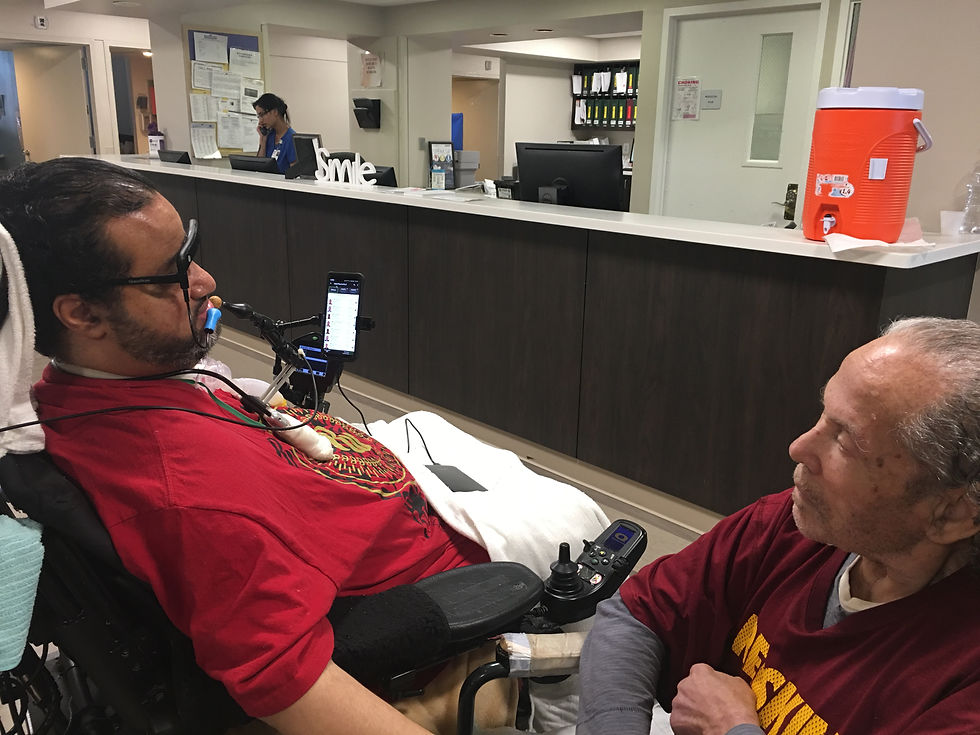
I didn’t want him to see his son struggling to do things he once taught me to do with ease. I didn’t want to see him worry about me. I wanted to remain the son who carried himself with confidence, not the one who needed assistance to move, to eat, to live.
But ALS doesn’t ask permission.
As my body weakened, my pride fought harder. Every offer of help felt like a test I was failing. Every moment of dependence felt like a public admission that I was no longer the man I once was.

And that’s when I understood something profound.
The men my father stood beside during the Civil Rights Movement—the Freedom Fighters—weren’t weak men. They were men who understood that courage sometimes meant sitting down when the world told you to stand alone. They leaned on each other. They trusted one another with their lives. They knew that freedom was never achieved in isolation.

My father taught that lesson with his life. I had just forgotten it.
The same courage it took to face mobs and hatred was required to face vulnerability and loss. The same strength it took to lead a movement was needed to accept support without shame.
When I finally allowed myself to ask for help, I didn’t become smaller.
I became freer.
Free from the exhausting performance of invincibility.
Free from the lie that strength means silence.
Free to be fully human.
I am still proud to walk behind his shadow.
But now I understand the truth:
Shadows don’t diminish us—they guide us when the light is harsh.
I began to see my journey differently.
Asking for help wasn’t weakness—it was resistance. Resistance against isolation. Against despair. Against the lie that a man’s worth is measured by how little he needs others.
Learning to ask for help became my new form of bravery.
I learned that allowing someone to care for me didn’t make me smaller—it made space for connection. I learned that vulnerability isn’t the opposite of strength; it’s a deeper version of it. And I learned that leadership sometimes looks like saying, “I can’t do this alone—but I’m still here.”
Just as the Freedom Riders challenged unjust systems, I had to challenge the internal system that told me real men don’t ask for help. I chose to sit in the seat ALS tried to deny me—the seat of dignity.
And in doing so, I found a new kind of freedom.
Freedom from pretending.
Freedom from shame.
Freedom from carrying everything alone.
I was still an Alpha—but my strength looked different now. It showed up in honesty. In trust. In courage that asked, received, and endured.
The Freedom Fighters rode buses toward justice.
I rode dependency toward truth.
And we learned the same lesson:
Freedom isn’t found in standing alone.
It’s found in the courage to keep moving—together.
My body may have weakened.
But the man my father raised—the man shaped by legacy, faith, and truth—still stands.

Comments